While You Were Sleeping
Last night, while Kentucky slept, the starts had company.
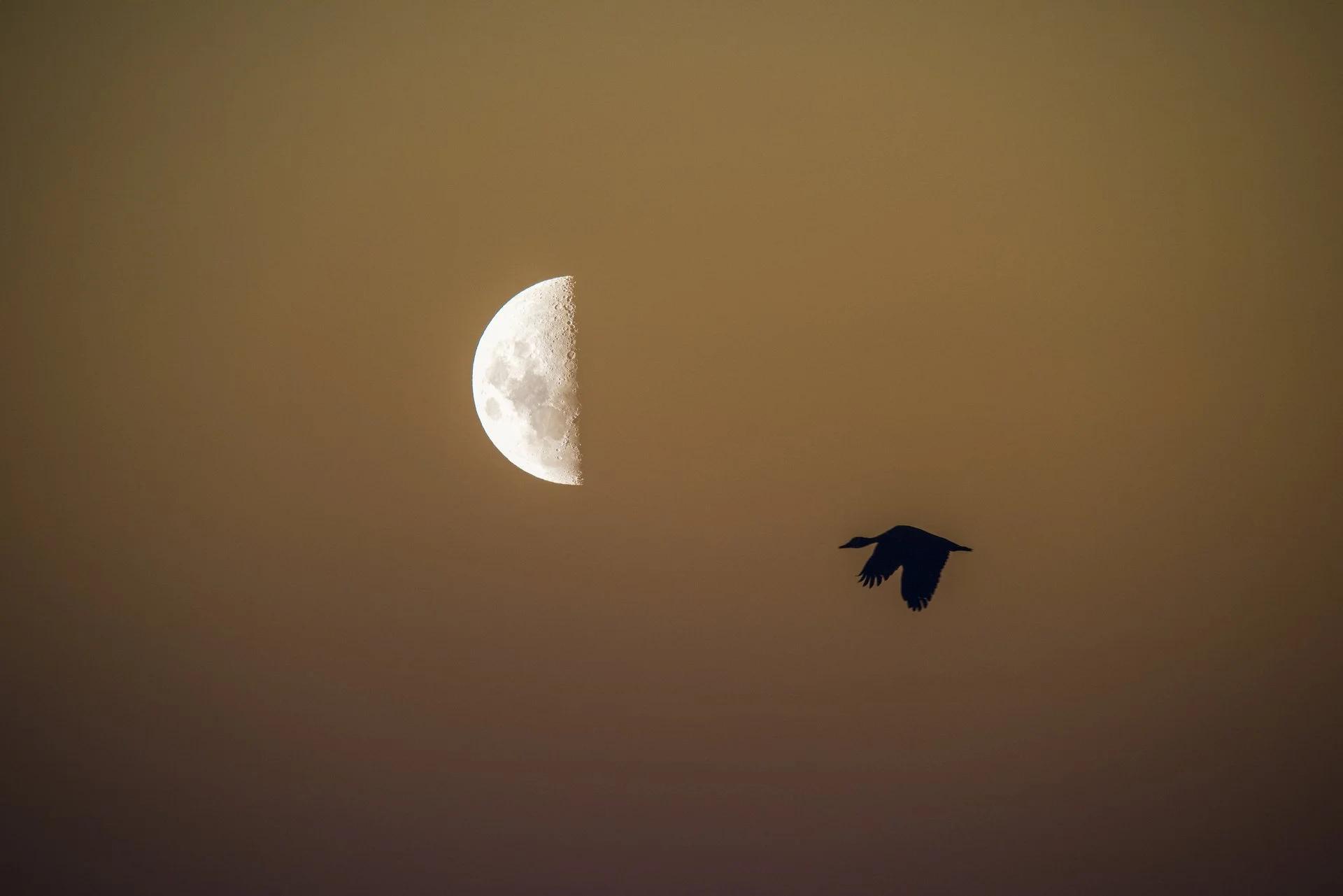
Photo by: Gabriel Rojo
Between 8 p.m. Sunday and 7:10 Monday morning, an estimated 23,713,600 birds passed overhead without waking the dog. Give each of them a single square foot and they would cover an area larger than the entire Disneyland Resort. Anyone else have a Hitchcock flashback after reading that?
You'd think 23 million wild animals would be hard to miss. Yet most of us did.
Think about this: Each year, travelers cross oceans and spend thousands of dollars for the chance to watch roughly 1.3 million wildebeest make their way across the Serengeti ecosystem.
Last night, 23.7 million wild animals passed through Kentucky. And we slept through it.
That's partly because one of the world's great wildlife spectacles is scheduled for third shift and it happens at roughly twice the height of the Eiffel Tower. Imagine trying to spot an ant in your neighbor's yard. Now turn the lights off.
But the stranger thing may be what sent them into the sky in the first place.
Birds, it turns out, have their own word for wanderlust.
Zugunruhe is a German word that translates roughly as “migratory anxiety.” It’s a state of restless agitation that birds experience before migration. Even captive birds experience it. It's a little like having an urgent need to pack for a trip you don’t remember booking.
Stranger still, some young migrants feel that pull before they've ever made the journey. They have no memory of the place they're headed, no previous route to retrace. Yet something tells them when it's time to leave and points them in the right direction.
Somehow, they miss a place they've never been.
Interestingly, last night wasn’t even close to the largest migration movement Kentucky has experienced. On Sept. 25 last year, BirdCast estimated that 83.6 million birds crossed Kentucky in a single night. BirdCast is a project of the Cornell Lab of Ornithology and partners that uses radar observations to estimate how many birds are migrating, where they're going, how fast they're traveling and how high they're flying. The birds are still largely invisible to us. Their numbers no longer are.
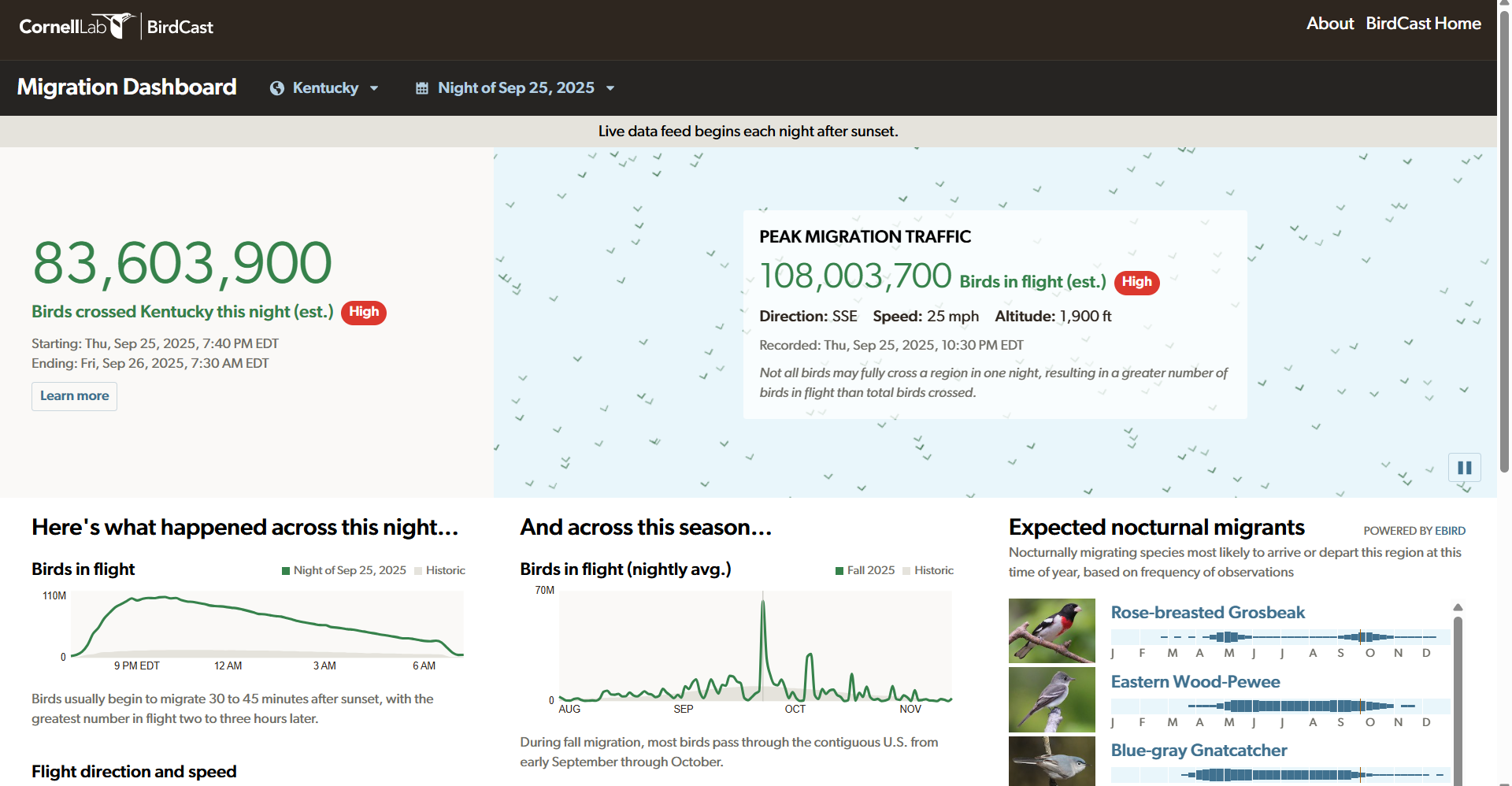
Image: BirdCast Migration Dashboard; Kentucky, Sept. 25, 2025. Cornell Lab of Ornithology.
While the scale of the migration is extraordinary, the individual journeys may be even more so.
Some species partake in the biannual avian ultramarathon in a radically sleep-deprived state. Researchers studying migrating Swainson's thrushes found that the birds took frequent daytime micro-naps lasting mere seconds. Apparently, when there isn't enough time to sleep, one solution is to make sleep smaller.
And sleep isn't the only logistical challenge. There is also the minor matter of finding south. Birds undertake these journeys of hundreds or thousands of miles using information that humans can barely perceive. Some birds can use patterns in the night sky to orient themselves. Others can detect Earth's magnetic field, giving them access to a compass that has been beneath our feet all along. Humans invented GPS because apparently the stars and Earth’s magnetic field weren't sufficiently obvious. Birds have managed just fine without the upgrade.
And nearly all of this happens in darkness.
For millions of years, night reliably arrived. Then we turned on the lights.
For birds traveling at night, particularly those passing through cities, light can attract and disorient them, pulling them from their routes and costing precious energy they need to continue their journeys. For an animal traveling on a budget measured in calories, detours are expensive.
Louisville, the Ohio River, and the region's parks, forests, backyards, and other green spaces provide places for migrating birds to stop, feed and recover. Some will stay. For others, it’s just a layover.
Lights Out Louisville, an initiative of the Louisville Audubon Society, works across Kentucky and Southern Indiana to reduce unnecessary artificial light during spring and fall migration. The message is simple: turn off unnecessary exterior lighting, close blinds and curtains, use timers and motion sensors, and direct necessary outdoor lighting downward.
In other words, make night look a little more like night.
Tonight, the stars will have company again.
But we probably won’t notice. We tend to think of wilderness as “somewhere else.” A national park. An African plain. A place requiring airfare and binoculars and possibly several vaccinations. Meanwhile, one of the largest movements of wildlife on Earth passes right over our roofs.
Sometimes the wilderness is 2,100 feet above your own backyard.