Wildlife Spotlight: The African Impala
For many safari-goers, the impala is both the first animal they photograph and the first they stop photographing.
It’s easy to understand why.
Across much of eastern and southern Africa, impalas are everywhere. Agile, abundant, and seemingly ubiquitous, they soon become part of the scenery as attention turns toward lions, elephants, leopards, and the other celebrities of the African bush.
This is rather unfair.
Because beneath all the apparent ordinariness is an animal that’s become extraordinarily good at the difficult business of staying alive.
Impalas are sometimes nicknamed the McDonald’s of Africa, partly because of the black M-shaped marking on their hindquarters and partly because it can be difficult to drive very far without encountering one. Or fifty.
The joke also contains an uncomfortable truth. Impalas occupy a prominent place on an alarming number of menus.
Lions eat them. Leopards eat them. Cheetahs, hyenas, African wild dogs, crocodiles, and large pythons also partake. For an impala, the African bush is less an idyllic wilderness than a landscape populated by hungry things.
And yet they flourish.
In a place where nearly every major predator would happily make a meal of you, abundance isn’t a sign of mediocrity.
It’s a remarkable evolutionary achievement.
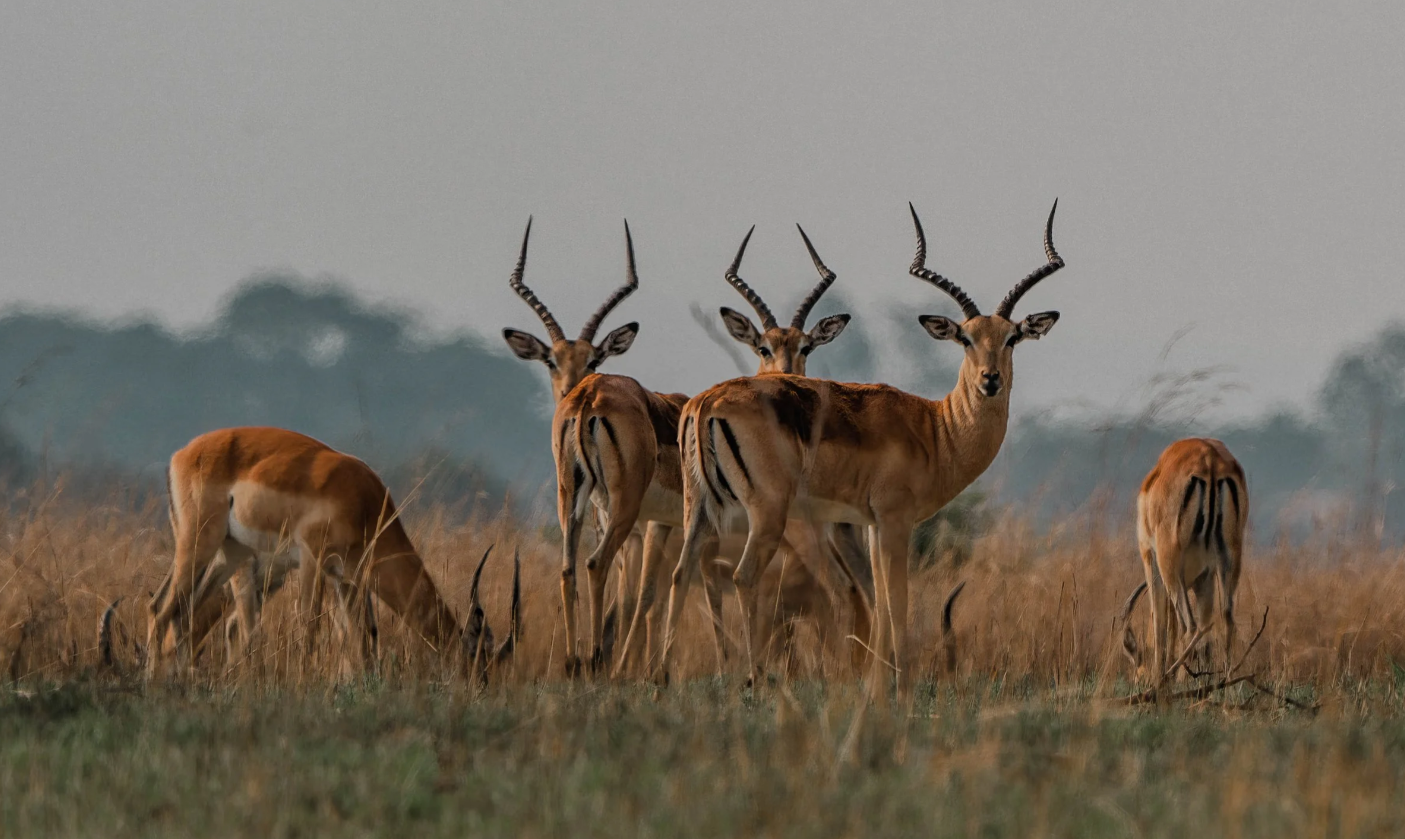
Born Ready
An impala arrives in the world with an impressive collection of anti-being-eaten equipment.
Their long, slender legs are capable of explosive acceleration and abrupt changes of direction. An impala can leap more than 30 feet in a single bound and nearly 10 feet into the air. They’re almost gratuitously athletic, but there’s method to the exuberance. Unpredictable movement makes it considerably harder for a predator to calculate where it will be next.
Even at rest, impalas are rarely entirely at rest. Their enormous ears swivel independently, collecting sounds from different directions, while their large eyes provide a broad field of view. Herd life adds another layer of security, allowing some animals to graze while another keeps watch.
The next time you see them, resist the temptation to say: Oh, it’s just impalas.
Look closer. Rarely does an entire herd lower its guard at once. One impala is almost always watching.
Africa’s Hardest-Working Bachelor
For a male impala, becoming the dominant ram is quite the achievement. Remaining one is a full-time occupation.
For a brief period each year, otherwise composed males become surprisingly dramatic.
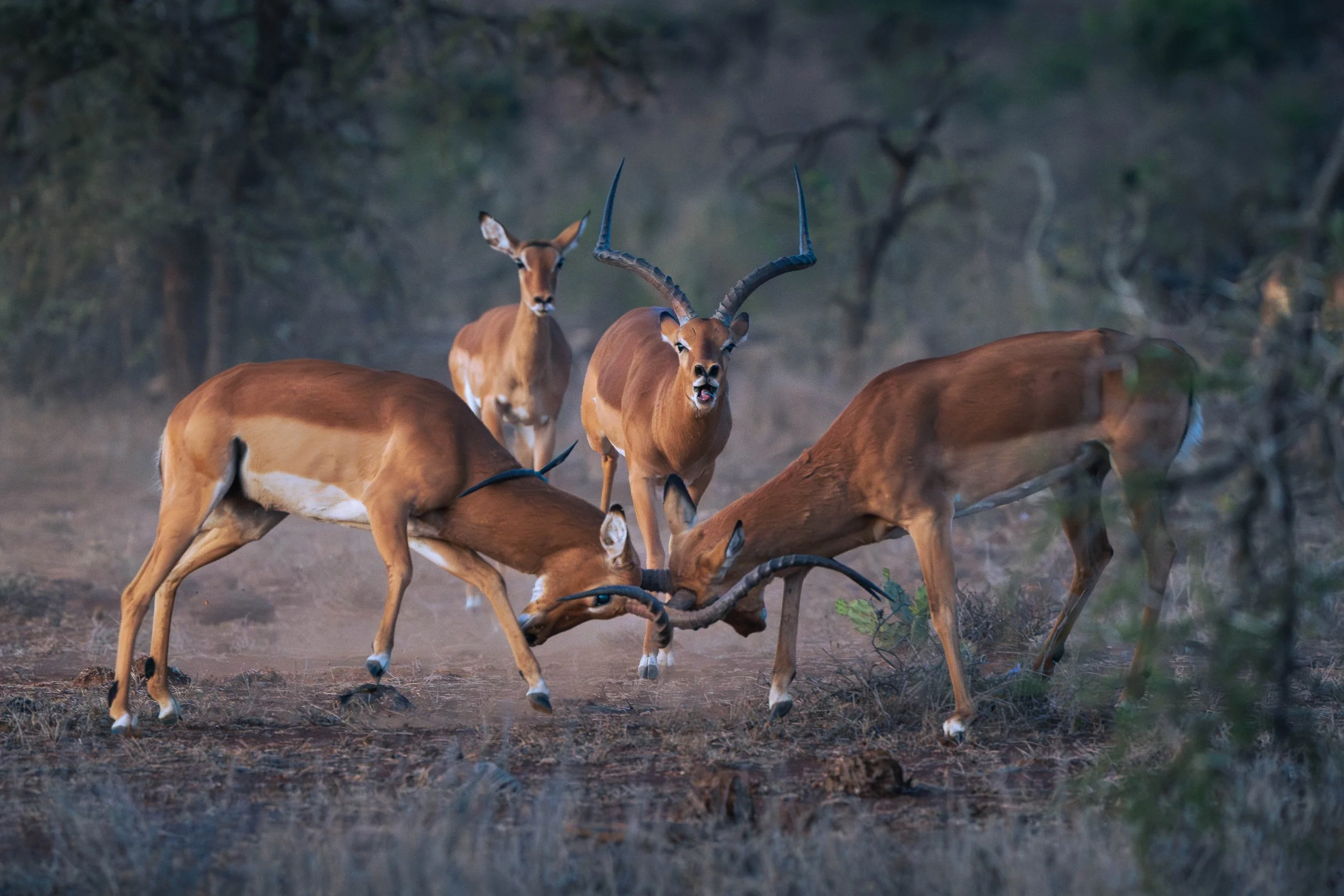
They posture. They chase rivals. They herd females. And they spend so much time defending their territories that they may forget to eat (an impressive commitment, if an ill-advised one).
By the end of the rut, males can lose substantial body weight—a reminder that romance in the African bush comes with a physiological invoice.
Female impalas have rather different concerns.
After a gestation of roughly six to seven months, females give birth to a single fawn. Newborns are extraordinarily vulnerable, so mothers may conceal them in dense vegetation during the first days of life, returning to nurse until the youngsters are ready to join the nursery herd.
Throughout the year, impala society shifts with the seasons. Bachelor groups assemble and disperse. Female herds merge and separate. Males establish territories and then lose them. The apparently placid collection of antelope beside the road is, on closer inspection, a rather fluid society of sex, hierarchy, competition, motherhood, and shifting alliances.
The Virtues of Being Unfussy
One secret to the impala’s success is that it’s not terribly doctrinaire about dinner.
Unlike herbivores that lean heavily toward one feeding strategy, impalas decline to choose.
They are mixed feeders, happily grazing when grass is green and nutritious and turning to leaves, shoots, herbs, seedpods, and other vegetation as conditions change. When the rains arrive, they exploit the sudden abundance of fresh growth. As the landscape desiccates, they alter both diet and movement to accommodate what remains.
It’s difficult to overstate the usefulness of not being fussy when your pantry is controlled by rainfall.
That dietary flexibility helps impalas occupy a broad range of savannah and woodland habitats across eastern and southern Africa. Because they’re not dependent upon one particular resource remaining available.
Specialization can produce some of evolution’s most marvelous oddities. But when circumstances become difficult, there’s much to be said for eating what’s on offer.
More Than Something Else’s Dinner
The impala’s reputation as prey can obscure its larger ecological importance.
Certainly, predators depend upon them. Their abundance makes impalas an important food source for many carnivores. But impalas participate in the landscape in other ways too.
Their grazing and browsing help shape vegetation. Their movements redistribute nutrients. And their vigilance creates information that other animals exploit.
It's not unusual to see zebras, wildebeest, giraffes, or even baboons paying close attention when nearby impalas stare fixedly into a thicket.
Experienced guides do too.
Because somewhere inside that thicket, there could be a leopard that’s wishing everyone would stop looking.
The Gift of Looking Closer
Perhaps this is greatest lesson the impala offers.
On a first safari, it’s entirely reasonable to become besotted with elephants, lions, leopards, and the other animals whose presence seems to rearrange the atmosphere around them. Rarity and grandeur exert their own gravitational pull.
Impalas are different. Elegant without being flashy. Common without being ordinary. Constantly alert, endlessly adaptable, and woven into nearly every story unfolding across the savannah.
Commonness, it turns out, isn’t the same thing as ordinariness.
Impalas may not earn top billing on most people’s safari wish list. But look closer. They teach us about relationships, compromises, signals, appetites, opportunities, and exquisitely evolved ways of not dying.
That’s one hell of a trick.