Even- and Odd-Toed Ungulates and Other Career Decisions
There are, as it turns out, rather more kinds of bird feet than I had previously considered necessary.
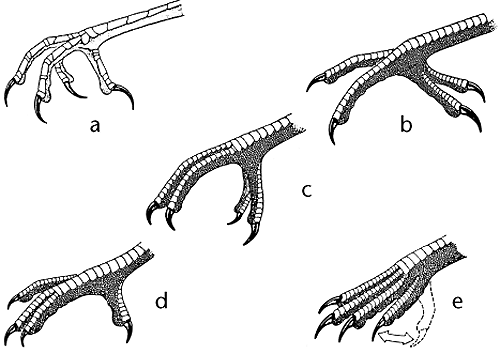
Anisodactyl. Zygodactyl. Syndactyl. Pamprodactyl.
Before studying to become a field guide, I was operating under a considerably simpler taxonomic system: bird feet. I had spent years admiring birds, learning to identify them, and accumulating enough ornithological knowledge to feel reasonably pleased with myself.
My confidence didn’t survive the syllabus.
But I’m getting ahead of myself.
My relationship with wild places began, rather conventionally, with a camera. I wanted beautiful light, interesting behavior, the exquisite moment when everything comes together and you know, before pixel peeping, that you got the shot. But the more time I spent in wild places, the more interested I became in everything else.
The natural world had been conducting a conversation around me for years. I had been photographing the speakers without understanding the language.
I also developed a rather inconvenient habit of falling a little bit in love with my field guides. For a while, I dismissed this as an occupational hazard of safari. Beautiful place + charismatic wildlife = Hollywood romcom.
Eventually, I realized I’d misidentified the object of my affection. It wasn't the guides. It was their job. I envied the fluency with which they read a landscape. They could take dozens of seemingly unrelated observations, reconstruct what had happened, then make an uncannily good prediction about what might happen next. It was ecosystem forensics, and I wanted in. Not casually. Not as an enthusiastic amateur accumulating interesting wildlife facts like intellectual souvenirs. I wanted to know everything.
So I enrolled in field guide training.
That’s how my life came to include carrying capacity, cold fronts, neurotoxic venom, ruminant stomachs, insect wing pairs, frog sex, and, inevitably, bird feet.
A bird's foot, I learned, isn't merely a foot. It's a résumé.
Want to know a bird’s professional qualifications? Look at its toes. Three toes forward and one backward? Perching is a core competency. Two toes forward and two backward? Climbing and gripping. I had been looking at birds for years but completely ignoring their evolutionary LinkedIn profiles.
I studied. For months.
Flashcards multiplied. Post-it notes colonized mirrors. My brain became a poorly zoned neighborhood of mammalian dentition, cloud formations, and sexual dimorphism. I learned about plantigrade, digitigrade and unguligrade locomotion. I memorized primary, secondary and tertiary flight feathers, amplexus, oviparity, viviparity and ovoviviparity. I learned why some animals walk on their toes, why lizards occasionally abandon perfectly serviceable body parts, how frogs arrange their romantic affairs, and how to find south using the stars—actual sorcery for someone who’s been outwitted by the navigational complexities of a parking garage.
Eventually, all this newfound erudition required verification. It was time to sit for the NQF2 theory exam and my months of accumulated natural history were invited to present themselves for inspection.
The exam was unexpectedly carnivorous. All my life, I’ve been an annoyingly good test-taker. This time, I didn’t emerge with an insufferable degree of confidence. I was grateful to have survived with all my limbs intact, but with no clue if I had passed.
Weeks later, after a long day searching for snow leopards in a Mongolian winter cold enough that the moisture on my eyelashes recomposed its physical state, I was warming up in a ger and enjoying a delicious bit of Wi-Fi when the email arrived. Three words forever changed my career trajectory. “Congratulations, you passed.” Several celebratory drinks immediately volunteered for duty.
Passing the NQF2 theory exam is just the beginning. There’s more field training, more studying, and more guiding ahead.
And I’ve realized something else. Careers have ecosystems too.
Photography. Writing. Travel. Natural history. For years, I'd treated them as separate species. Wilder Aperture is what happened when I finally stopped trying to keep them apart.